Recently, a team led by Professor Liu Ren from Jiangnan University proposed a new method for ceramic printing, which combines direct ink writing and near-infrared induced conversion particle-assisted photopolymerization to achieve 3D printing of multi-scale, large-span ceramics without support.
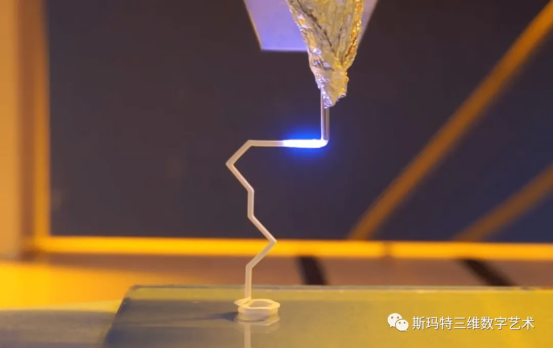
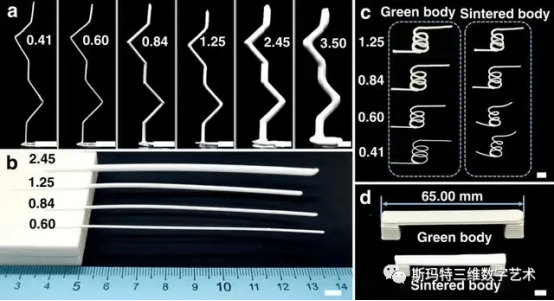
The technology can solidify multi-scale filaments in situ with a diameter ranging from 410 µm to 3.50 mm, and successfully fabricate ceramic structures such as twisted springs, three-dimensional bending, and cantilever beams through support-free printing. This method will bring more innovations to the additive manufacturing of complex-shaped ceramics.
This printing technology enables the in-situ curing of multi-scale continuous filaments with diameters ranging from 410 microns to 3.50 mm, and successfully constructs ceramic structures such as twisted springs, three-dimensional bending, and cantilever beams through support-free printing. The research results of this team were published in the journal Nature Communications on April 25.
The new slurry is a photo-ceramic slurry that rapidly cures and increases strength when exposed to near-infrared (NIR) light. At a certain NIR radiation intensity, the material maintains its shape immediately after being extruded from the nozzle in mid-air.
"The printed curve can extend freely in space without support. The printing process is smooth and continuous, without the need for heating or cooling," Liu Ren said in the paper.
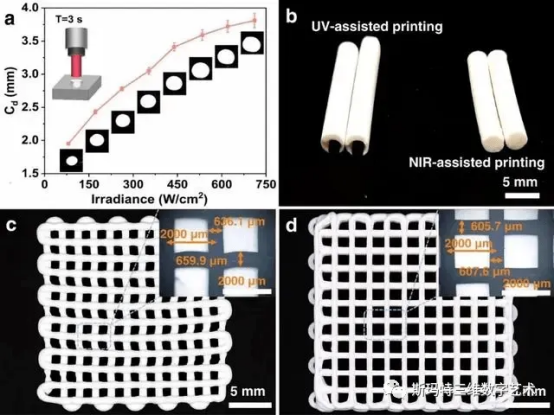
The researchers also showed that NIR light can achieve better results compared to the commonly used ultraviolet (UV) light. The depth of curing of the paste was tested under both NIR and UV light — a quantity often used to characterise light penetration.
Why support-free ceramic 3D printing is so critical?
In traditional ceramic 3D printing, additional support structures are often required to prevent the collapse of unsupported parts. This extra skeleton not only affects printing efficiency but also introduces issues related to the removal of these supports. To address these challenges, Professor Liu Ren and his team at Jiangnan University have developed a new printing slurry and improved curing technology that can help materials solidify rapidly, enhancing the efficiency of ceramic 3D printing and eliminating the need for support structures.
"The key to this technology is not only the elimination of the support required in a typical printing process, but also brings many other advantages, such as reducing print time, material usage, and post-processing workload," Liu Ren said in the paper.
The team said the new technology for 3D printing ceramics in air has the following advantages:
1. Fast printing speed: Due to the fast curing characteristics of the slurry, each layer of printing only takes a few seconds.
2. High resolution: Due to the low viscosity and high solid content of the slurry, it is possible to achieve resolutions at the micro米甚至 nano米 level.
3. Post-processing is simple: Since the slurry does not contain organic solvents or other additives, only simple cleaning and drying are required.
4. Low cost: Since no inert atmosphere or vacuum environment is required for printing, it saves on equipment and operating costs.
5. Material diversity: Since slurries can be prepared using a variety of ceramic powders, a wide range of functional and performance ceramic materials can be achieved.
The team believes that this new technology of 3D printing ceramics in the air brings revolutionary changes to the ceramics industry, greatly expanding the application prospects of ceramic materials in aerospace, automotive, biomedicine and other fields.
China has made significant progress and achievements in the field of 3D printing. At present, China has more than 100,000 3D printers, and its market share has reached more than 20%. Looking forward to the new era of 3D printing, the future of 3D ceramic printing is shining brightly!